It's been a tough year. I covered the beginning of the year in another post regarding the Calculus course I took in preparation for applying to a master's program in applied statistics. I had planned on studying for the GRE this summer and taking it this fall as well as applying for the master's program, then working through the master's program for the next 3-5 years. My employer, HDMS (a subsidiary of Aetna), was going to help pay for the degree. However, those plans were going to get thrown off course.
I had just finished submitting my coursework for reimbursement when I was sent an out-of-place meeting request. At the meeting, I found out HDMS was letting me go. At first it appeared it was just me, but as I found out later in the day, they were laying off about 10 other employees and closing about 10 other open positions. For two hours, I was trying to figure out what I did wrong - but it had nothing to do with my performance. I was the most recent hire on the team, and there were others getting laid off too.
I hit the ground running. The severance package included a career consulting service - I looked it up and scheduled time to review my resume with a consultant. The paper / PDF version has undergone quite a few revisions over the past few weeks. I also started contacting my network, browsing through online job boards, and all the usual job-hunting tasks. I did find quite a few roles through my network, and a couple of them resulted in offers.
I quickly found a role as a consultant data analyst with Great Wolf Resorts. I stayed there for a few weeks, working on a single project integrating credit card transactions with the reservations. Essentially, if a guest uses a credit card for something on site (e.g., restaurant) and does not charge it back to the room, the transaction is not connected to the reservation. In order to connect the two, I had to merge transactions with reservations based on guest name and, if available, the last four digits of the credit card number. It was messy, and I was able to get about 57% of the transactions matched. I believe the best possible rate was somewhere around 65%, but it would have required a lot of exception handling, manual matching, and/or time-intensive matching processes (e.g., matching text within another text field). The company analyst and I decided the additional matches weren't worth the expense.
The position was a good fit for my skills, and I enjoyed working with the people there, but as a consultant role, the benefits were very expensive and of course it could have ended at any time. So, I kept looking for permanent roles while I was there. I need something more permanent right now, but I can definitely see myself as a successful consultant. In my short time there, I think I demonstrated a lot of value with my skills and the process and analysis I left behind.
Recently, I found a new role as a Senior Healthcare Analyst at SSM Health, a non-profit healthcare organization with hospitals from Wisconsin to Missouri. They also own Dean Health Plan, where I worked a few years ago. I still know a few people there, so it will be good to reconnect with them. I'll be analyzing healthcare data for a particular region of the system, starting in a few days. I feel very good about the team and the leader, so I'm looking forward to getting started. Luckily, I'll be working from home again, so I'll get to use my treadmill again.
Here's hoping quarter four is quite a bit less turbulent!
Showing posts with label Career. Show all posts
Showing posts with label Career. Show all posts
Wednesday, September 13, 2017
Tuesday, August 1, 2017
Calculus III
In the last year or so, I decided to apply for a master's program in applied statistics, but I was missing one of the prerequisite mathematics courses: Calculus III. I had taken calculus courses in high school and college, but those courses were more focused on applications. Furthermore, I hadn't covered any of Calculus II in those courses.
Instead of taking the entire series, which would have taken quite a bit of time and money, I decided to do something rather daunting: I took Calculus III online and used Khan Academy and other sources to catch up on Calculus I and II. I read reviews that the first few weeks were tough even if you had taken Calculus I and II just before III. Undeterred, I started the course earlier this year, and the first few weeks were indeed tough.
The online program I used - NetMath - used an online math tool for running code and submitting homework. Each student is assigned to a mentor who grades assignments, answers questions, and ensures each student is on schedule. Students receive feedback on their homework and are able to re-submit corrections a couple of times. The two midterms and final must be taken in person with a proctor.
My first mentor was not very responsive. On week 2, a critical week in the program, my mentor did not respond to emails or grade my assignments in a timely fashion (within 3 days, as noted in the program handbook). I notified the program administrators and they assigned me a new mentor. She had quite a bit of catching up to do, but she did her best and eventually graded the outstanding assignments and responded to my questions. Honestly, she was amazing, and I'd write her a letter of recommendation if she asked.
Lesson 2 is quite difficult. It's really the first lesson on the topic of the course, where lesson 1 was review of parametric equations and other necessary concepts, and it's there in case anyone missed or forgot these topics. With the combination of difficult content and slow responses from my mentor, it took me 2 weeks to finish lesson 2. In addition, I got sick for a couple of days and there was a death in the family, which put me behind another 2 weeks or so. Fortunately, the program offers a two-month extension, and I planned on using it if needed.
However, there were additional, serious problems with the course. One of the most grievous was incomplete or incorrect content. There were often no terms given to ideas, preventing students who have taken this course from communicating the concepts effectively. For example, vector projection was just called "vector push on another vector". It took me quite some time to find the right term to be able to research this concept online.
The course also neglected saddle points and claimed that whenever a gradient was {0, 0} (or more zeros depending on the number of dimensions), that the point was a minimum or maximum of the function. This is blatantly not true when a saddle point is present, and it would be terrible for students to internalize this falsity since it is profoundly meaningful in calculating predictive models with machine learning, specifically neural networks. You can't assume you've optimized a function when the gradient is {0, 0} without looking around it to see if you've found a saddle point.
All told, I was quite unhappy with this course. Not only was I spending a lot of time catching up, but I was spending time trying to learn the material through other sources since the course material was incomplete or inaccurate. Nearing the end of the course, I was able to catch up to the point where it looked like I could finish the course if I just had another week or two. I emailed the administrators for a course extension, noting the reasons I had for the delay and the issues I had with the course, and they offered a shorter extension so I could finish it without rushing and without taking the full extension. (My schedule to finish without an extension would have been very demanding for my mentor to complete all the grading in time.)
Despite all the delays and issues, I finished all the material within the original time frame, and I just needed to take the final. I studied for a few extra days and took the final about 2 weeks after the course originally ended. Since the final was comprehensive and included the last three lessons, I was very nervous about it. I had aced the midterms, but there was just so much to remember (e.g., the curl of a 3D field is difficult to remember). To my great surprise and delight, I not only aced the final, I got an A+ in the course. I was relieved!
Now I just have to re-take the GRE and apply for the master's program.

Thursday, March 20, 2014
Pizza Day Award
At CPM Healthgrades, we have a monthly Pizza Day. Originally the idea was to honor employee birthdays and work anniversaries, and instead of buying each person lunch on multiple days, leadership bought everyone lunch, specifically pizza, once a month.
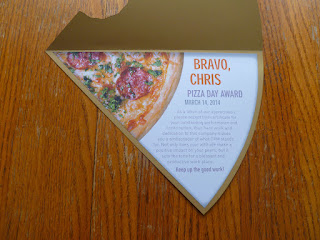
Before the pizza would arrive, someone would read a list of employee birthdays and anniversaries. Eventually, leadership realized that the lists were too long and dropped specific recognition. However, they still announce new employees, company news, and honor an employee of the month. Nominations are requested for employee of the month, called the Pizza Day Award, and the nominations, sometimes amusing, are read aloud. The winner receives the Golden Pizza Slice (pictured above).
This month, I was nominated. Twice! Before I get to their nominations, I need to explain a certain recurring theme.
My coworkers, Andrew and Brian, dressed as a horse and stead for Halloween. The company was having a costume contest. Andrew wore a chain mail tunic and a shield with a skull on it (both self made!). Brian wore a horse head mask, and he hefted Andrew on his back for the contest pictures. The pictures were then sent out for everyone to vote for the best costume. (Of course, I voted for them.) The horse head mask ended up in Brian's cubicle, where it still remains.
Inspired by Brian's horse head, I brought in my own horse head, a marble book end. So apparently the Analytics Team's mascot is a horse.
So with that explained, here are their nominations. First, Brian's:
It reads:
I appreciate the recognition, especially since the work out team does is quite well hidden, in databases and used in software. Thanks Andrew and Brian!
Before the pizza would arrive, someone would read a list of employee birthdays and anniversaries. Eventually, leadership realized that the lists were too long and dropped specific recognition. However, they still announce new employees, company news, and honor an employee of the month. Nominations are requested for employee of the month, called the Pizza Day Award, and the nominations, sometimes amusing, are read aloud. The winner receives the Golden Pizza Slice (pictured above).
This month, I was nominated. Twice! Before I get to their nominations, I need to explain a certain recurring theme.
My coworkers, Andrew and Brian, dressed as a horse and stead for Halloween. The company was having a costume contest. Andrew wore a chain mail tunic and a shield with a skull on it (both self made!). Brian wore a horse head mask, and he hefted Andrew on his back for the contest pictures. The pictures were then sent out for everyone to vote for the best costume. (Of course, I voted for them.) The horse head mask ended up in Brian's cubicle, where it still remains.
Inspired by Brian's horse head, I brought in my own horse head, a marble book end. So apparently the Analytics Team's mascot is a horse.
So with that explained, here are their nominations. First, Brian's:
I’d like to nominate Chris Swenson for a pizza day award this month for his hard work on the PDC configuration workbook. He really didn’t horse around when it came to bringing this old mare up to date, he saddled right up and did what needed to be done. Now we have a true thoroughbred of a workbook on our hands, allowing us to configure markets much more rapidly and accurately than ever before. We all really appreciate the hard work he’s put into this project and feel he deserves some recognition for his efforts.And here's Andrew's:
I would like to nominate Chris Swenson for the pizza day award. Even though he has been yoked down by various research requests, he’s managed to plow through the workbook to make it dramatically more useful. The old version can now be put out to pasture while the improved version really gallops along like the true stallion it is. His efforts have reduced the PDC analysts work load by several hours per request. He’s really a horse of a different color.At Pizza Day, the reader was instructed to take careful note of the theme. I was selected, and I wonder if it was mostly because of the amusing nominations. At any rate, I received the Golden Slice Award:

It reads:
As a token of our appreciation, please accept this certificate for your outstanding performance and contribution. Your hard work and dedication to this company makes you a ambassador of what CPM stands for. Not only does your attitude make a positive impact on your peers, but it sets the tone for a pleasant and productive work place. Keep up the good work!Along with the Golden Slice came a $50 gift card!
I appreciate the recognition, especially since the work out team does is quite well hidden, in databases and used in software. Thanks Andrew and Brian!
Tuesday, November 12, 2013
What is a Data Scientist?

Today on Quora, someone asked, "What are some software and skills that every Data Scientist should know?". I wrote the following as a response, reflecting on my current position and the role I play.
I started adding post-it notes with sub-titles to my name/title tag on my cube, as sort of a joke regarding the question, "What is a Data Scientist?".
Here's the current list:
- [Client] Analyst
- [Product A] Analyst
- Financial Analyst
- Sales Analyst
- Contract Analyst
- Quality Assurance Analyst
- Call Center Analyst
- Data Surgeon (aka, data mining with the intent to figure out what's wrong)
- Data Diagnostician (alternative of above, maybe with no details to examine)
- [Product B] Analyst
- Database Developer
- Bug Finder (as in software bugs)
Each of our clients has its own relational database, so we do "meta-queries" to access them one by one in order to answer a question. That's sort of data science like. Eventually, though, we're going to have one master database with all clients that will cascade into individual databases. So our "meta-queries" will be obsolete.
We deal with a lot of "big data" too, but it's usually not that big of a deal. Even with relational databases, it's okay. Some queries may take a little longer (30-60 minutes), but that's rare. We have some machine learning tasks that pull in massive training data sets, so at that point you have to be more careful about "big data" problems like running out of RAM or disk space. But it can be handled, and rather simply.
What I really wish I could do more of is machine learning, and while I've accumulated several ideas that would enhance products or help us make better decisions in the year I've been a Data Scientist, these other tasks take up most of my day.
In the end, I write a lot of SQL, use the Linux command line moderately, and report on data in Excel spreadsheets. I use Python occasionally to write scripts. And I'm always learning something new (new SQL techniques, Python libraries, Linux command line tools, etc.).
Wednesday, February 6, 2013
My Professional Network, Graphically
A few months ago, I was thinking about my professional network and wondered what it would look like if it were mapped out. It turns out, LinkedIn has a lab project to do just that. I loaded up my profile and a few minutes later, this came out (click for larger version):
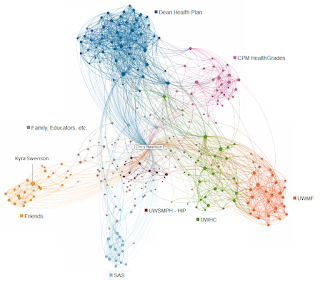
Each dot in the above chart represents a person, and each line represents a connection between people. The larger the dot, the closer the relationship. I am at the center, and unique clusters of people become apparent by their interrelationships, and they are grouped together in space.
The lab does not label the clusters, but it does identify the clusters by color, and it allows the user to identify those clusters and name them, as I have done above. Further, you can explore your network by hovering over the individual dots that represent people.
Essentially, five groups arise from my network: Family, Friends, and Educators on the left; Dean Health Plan at the top; CPM Healthgrades at the upper right; the UW Health System, which is composed of the University of Wisconsin Medical Foundation (UWMF), the University of Wisconsin Hospitals and Clinics (UWHC), and the University of Wisconsin School of Medicine and Public Health (UWSMPH); and finally the SAS Institute at the bottom.
The lab isn't perfectly accurate, but it is pretty good. I checked out a number of individuals and some don't make sense, but most do. As an example, my wife is one of the larger dots on the left, which makes sense, since she also has networked with our friends and family on LinkedIn (although I usually avoid doing so for a number of reasons).
The UW Health cluster is visually split, but there is apparent movement and interrelationship between the organizations. There are some people who traveled between the UW and Dean, one way or another. The same is true between Dean and CPM, with most, I believe coming from Dean to CPM. There are some hubs in each organization, likely managers, project managers, or other people who attended a lot of meetings (I think one of the big dots at Dean was an IT manager who sat in on a lot of projects).
Aside from family and friends, SAS is probably the oddest group. I have some connections, and they seem to be somewhat strong. Before I attended the SAS Global Forum, this chart may have looked quite different, since I made many more connections after the conference. The chart also shows how well-developed my connections were at Dean and the UW, and how I'm still fairly new at CPM. (I bet if I ran this today it would look a bit better developed.)
Of course, charts like these leave out people who aren't on such sites as LinkedIn, but I would think that all the other people would compensate for them when graphed like this. Additionally, I don't have much of a network for old jobs like the ones I had in college, nor have I really networked much with fellow college classmates.
It would be interesting to see what other people's networks look like, especially people who are essentially professional networkers, like HR professionals or recruiters. How do networks in different industries look (mine is mostly health care)? What if you have someone who only networks with family or friends? What does that show? Perhaps different geographic locations you've lived in? How about someone who is a world traveler?
This type of graph is very powerful in that makes you think about the data behind it and ask such questions as I have done. It opens up doors we haven't thought of and inspires curiosity.
Saturday, September 22, 2012
Two Special Notes
A few weeks ago we were packing up all our stuff to move to our new house. During this process, I found two notes from former coworkers, delivered on my last day of work at different jobs. Here's the first:


Here's the transcription in case the image does not appear:
And here's the second:


with the text:
I kept both notes because they are very meaningful to me, and I think this highlights how important it is to write hand-written notes of thanks to you colleagues: It can be touching, powerful, and memorable for the recipient, and the writer has earned a relatively permanent place in memory. It's a perfect way to not only show genuine gratitude, but also earn a positive place in the recipient's mind, whether for the purpose of networking, friendship, or simple kindness.
Here's the transcription in case the image does not appear:
Dear Chris —
I have enjoyed watching you learn and grow over the last couple of years. You have become and excellent analyst — UWMF is lucky to have you. I will miss your superb work, smiling face and Luca stories! Best of luck to you on this exciting step in your career! I wish you, Kyra and Luca much happiness!
Sincerely,
[name]
And here's the second:
with the text:
Chris
I really appreciate the time and dedication and professionalism that you offered to the [organization's] projects and my RA project in particular. You pressed on to make this all possible, and I am grateful. Regrets for the frustrations along the way, but know that your contribution will be remembered.
All the best with your next personal + professional pursuits! Congrats on the well deserved Scientist position!
Thank you,
[name]
I kept both notes because they are very meaningful to me, and I think this highlights how important it is to write hand-written notes of thanks to you colleagues: It can be touching, powerful, and memorable for the recipient, and the writer has earned a relatively permanent place in memory. It's a perfect way to not only show genuine gratitude, but also earn a positive place in the recipient's mind, whether for the purpose of networking, friendship, or simple kindness.
Sunday, May 27, 2012
Update in May 2012
Last year around this time I had decided to take a risk and leave my position at the University of Wisconsin Medical Foundation for a position at the UW School of Medicine, where I was hoping to be more involved with research. This endeavor hasn't turned out as I expected, so I've decided to move on. Starting later this month, I'll be working with CPM HealthGrades, a marketing firm that is offering more and more data services to their customers.
I accepted the position at CPM HealthGrades as a Data Scientist. This is a pretty cool opportunity in a relatively new field of data analysis, using some of the same technologies behind IBM's Watson computer, the computer that bested two top-rank Jeopardy winners. I'll be learning the programming languages Python and R, and I'm really excited to put these skills to commercial and research use.
As you may know, I attended the SAS Global Forum conference last month, and I plan to keep up with the SAS community as well, by writing papers, presenting, staying in touch with user groups, and maybe even writing a book. So I plan on keeping my SAS site up-to-date; however, I may not be developing much new. Perhaps I'll come out with a Python or R site to go along with it, with translations of code back and forth between the languages. Heck, maybe I'll write a SAS macro to write Python, or a Python module to write SAS. We'll see! Stay tuned for more details!
Tuesday, July 12, 2011
News and Advice
Last week, I started a new position with the Health Innovation Program in the School of Medicine and Public Health at the University of Wisconsin-Madison. In this position, I hope to be more involved in research that could potentially affect patient care. Ever since my days doing academic and educational research, I have missed being involved in the process.
Along with this transition, it appears I've started to become a help desk of sorts for some SAS. I received two sets of email from different users of my macros, and I thought I would start sharing those questions and answers here:
Question 1:
Is there a way to limit the number of observations read by PROC IMPORT? I tried using OPTIONS OBS=2 before proc import and it worked but still the reduction in time was not significant.
Answer 1:
It depends on the file, so you'd have to look at the IMPORT procedure documentation depending on what you're importing to see if that feature is available.
Where did you put the option? It must have been just above the output. If so, then yes, it wouldn't decrease the time, since SAS is still pulling in all of the records. Depending on the location of the option, SAS may only keep the number of records on its way out of the import process. Either way, SAS may need to read the entire file, which would reduce time.
What if you tried just pulling in the header record, and delimiting them yourself? I'm guessing you're looking at comma-delimited, space-delimited, or tab-delimited data, and you should be able to figure out how to read the data in as one record, then split the variable names into multiple variables or even records. Then you could see if there are any new records.
Question 2:
Kindly help me to create the folders using SAS codes in local drive or on server without using X-command.
Answer 2:
You can use either CALL SYSTEM within a data step or %SYSEXEC. You'll want to tinker with the XSYNC and XWAIT options as you see fit. Here are two examples:
OR
Along with this transition, it appears I've started to become a help desk of sorts for some SAS. I received two sets of email from different users of my macros, and I thought I would start sharing those questions and answers here:
Question 1:
Is there a way to limit the number of observations read by PROC IMPORT? I tried using OPTIONS OBS=2 before proc import and it worked but still the reduction in time was not significant.
Answer 1:
It depends on the file, so you'd have to look at the IMPORT procedure documentation depending on what you're importing to see if that feature is available.
Where did you put the option? It must have been just above the output. If so, then yes, it wouldn't decrease the time, since SAS is still pulling in all of the records. Depending on the location of the option, SAS may only keep the number of records on its way out of the import process. Either way, SAS may need to read the entire file, which would reduce time.
What if you tried just pulling in the header record, and delimiting them yourself? I'm guessing you're looking at comma-delimited, space-delimited, or tab-delimited data, and you should be able to figure out how to read the data in as one record, then split the variable names into multiple variables or even records. Then you could see if there are any new records.
Question 2:
Kindly help me to create the folders using SAS codes in local drive or on server without using X-command.
Answer 2:
You can use either CALL SYSTEM within a data step or %SYSEXEC. You'll want to tinker with the XSYNC and XWAIT options as you see fit. Here are two examples:
data _null_;
call system('md c:\TestDir');
run;
OR
%sysexec(md c:\TestDir\);
Sunday, October 24, 2010
2010 Goals Revisited
Earlier this year, I wrote about goals for 2010. Here are the goals I documented:
- Complete all tasks as assigned for HEDIS 2011
- Submit HEDIS 2010 measures to NCQA
- Complete any post-HEDIS analyses
- Complete an internal leadership course
- Coordinate two projects to completion
- Complete another AHIP course
- Complete another SAS course (advanced macros or programming 3)
- Share SAS tools (e.g., macros, autoexecs) with other users
- Complete all tasks related to assigned quality-of-care measures for submission to Wisconsin Collaborative for Healthcare Quality (WCHQ)
- Complete any ad-hoc analyses
- Automate and update assigned production reports and processes (e.g., bulk emails)
- SAS: Document setup; organize user group to share knowledge, processes, and macros; and implement security procedures for stored Oracle passwords
- Provide support for other projects as needed
- Familiarize with organization structure, including existing process/data/knowledge silos, and begin the communication process to reduce such silos
Saturday, July 3, 2010
New Transitions
I have been working with an insurance company for almost two years, and I primarily worked with insurance claims to evaluate the effectiveness of care for our members and to discover patterns in care. Last week I accepted a new position with a physician clinical practice organization. The new position will provide experience on the other side of the health care industry, working with data from the doctor's office rather than the insurance company.
My wife, Kyra, is also looking for a new job. She's been having a rough time at her current child care center with the way it's being run. Last weekend she started submitting applications, and she's already had two interviews. She hopes to have a new job very soon, we hope with a daycare center where Luca can enroll and Kyra can seek state teaching certification. One day she would like to teach in an elementary school.
My son, Luca, has been growing rapidly. He's very talkative and he really seems to know what he wants. He enjoys going to school and visiting his friends. On the weekends, he's been taking swimming lessons and he loves the water! A bit too much actually--he really wants to swim on his own, but I'm sure he'd sink like a rock! Soon he will be two, and we hope to have a big birthday party for him.
So we're all undergoing changes. It may be a turbulent summer, but I hope we all end up a little older, a little wiser, and a little happier with these new transitions.
Subscribe to:
Posts (Atom)