There's a certain style of writing SQL that I really don't like. Here's an example that pulls names and addresses for people in Wisconsin and Illinois:
select p.name, a.address
from person p, person_address pa, address a
where p.person_id = pa.person_id
and pa.address_id = a.address_id
and a.state in ('WI', 'IL')
;
Basically, the author has stacked all the tables into the FROM statement, and specified how they join on the WHERE statement. This creates confusion about how the tables are intended to be joined as well as mixing actual filter criteria with the join conditions. However, it works, since the code results in inner joins between all tables, and that was okay.
My preferred style is like so:
select p.name, a.address
from person p
left join person_address pa
on p.person_id = pa.person_id
inner join address a
on pa.address_id = a.address_id
where a.state in ('WI', 'IL')
;
It's a bit more verbose, but that helps the reader. This style splits out the tables into different statements and results in clearly indicated join types and join fields. It is clear to a reader of the code the intention of joining each table. The filter criteria are located in the WHERE statement without any other statements to confuse them with. There are still cases where the result may not be as expected based on the filter criteria, but it's easier to debug.
Overall, the first example is a confusing style to use, and it can cause trouble if the joins were intended to be outer joins and were not, because the style does not have a way to specify outer joins. (LEFT JOIN is short for LEFT OUTER JOIN, which means, basically, return all records from the first table, and any data that matches in the next without missing any records from the first.)
The other day, though, I encountered a great way to use this potentially error-prone style in a way that is actually very useful.
I wanted to generate a master list of all potential ZIP codes in the US, and then filter out ones that are not in use or are otherwise invalid. I started by creating a small table with 10 rows that consist of 1 column with the numbers 0-9. With no loop statements available in SQL, I wrote this table like so:
create temporary table num (n int);
insert into num values (0);
insert into num select max(n)+1 from num;
insert into num select max(n)+1 from num;
insert into num select max(n)+1 from num;
insert into num select max(n)+1 from num;
insert into num select max(n)+1 from num;
insert into num select max(n)+1 from num;
insert into num select max(n)+1 from num;
insert into num select max(n)+1 from num;
insert into num select max(n)+1 from num;
insert into num select max(n)+1 from num;
delete from num where n > 9;
That last statement is just in case I ran it too many times. I was even too lazy to write out 1-9, instead just repeating the max+1 code 9 times. It's a bit over-the-top, but it works.
To get my "master" list of ZIP codes, I joined the table to itself 5 times, one for each character in the ZIP code (because they can start with 0s, they should be treated as characters, not numbers!). Here's how:
create table master_zip as
select n1.n||n2.n||n3.n||n4.n||n5.n as zip
from num n1, num n2, num n3, num n4, num n5
order by 1
;
Simple, isn't it? Essentially, this just makes a big Cartesian product of the table with itself times 4. There's no WHERE statement, because there's no need to join on anything. (If a system required it, I would just write "where 1=1".) This generates 100,000 records. That's about 58,000 too many, according the US Postal Service, so we need to delete some of those that are not in use. But that process is for another time.
Using a style that I usually do not recommend or warn against was interesting and useful, but it requires knowing a bit more about how these things work. Had I run this last bit of code on a larger data set, it would have caused a lot of problems, like running out of disk space or RAM. So use this style sparingly and carefully!
Wednesday, January 29, 2014
Friday, December 6, 2013
Happy Birthday to Me, From Me, Sorta
A few years ago, I worked at a company that uses SAS, and has a SAS server set up. I figured out that scheduling a SAS job was a bit clunky in Windows, so I mitigated the problem by setting up a SAS program run any tasks on a schedule, and then scheduling that task in Windows.
Since the program was evaluating dates and times to schedule tasks, I threw in a few happy birthday emails as a joke. A few years later, I woke up today to find this in my email inbox:
As a side note, the program also ran CheckLog, which reviews the SAS log output for issues, and it emailed the author about the status of the program. This was better than running CheckLog within a program, since the program could crash before it even got to the end, resulting in no status update when it was the most critical.
At any rate, it's good to know what I wrote is still useful, even if it contains a bit of questionable code!
Since the program was evaluating dates and times to schedule tasks, I threw in a few happy birthday emails as a joke. A few years later, I woke up today to find this in my email inbox:
Chris,Well, I'm surprised that's still running! At least it wasn't sent from my old account on that server: they had at least updated who was running the job. But I'm a bit surprised they still let this go. Either they don't realize that the scheduling code contains the happy birthday emails, or they don't mind.
Happy birthday! I hope you have a great day!
Sincerely,
The [Company Name] SAS Server
As a side note, the program also ran CheckLog, which reviews the SAS log output for issues, and it emailed the author about the status of the program. This was better than running CheckLog within a program, since the program could crash before it even got to the end, resulting in no status update when it was the most critical.
At any rate, it's good to know what I wrote is still useful, even if it contains a bit of questionable code!

Tuesday, November 12, 2013
What is a Data Scientist?

Today on Quora, someone asked, "What are some software and skills that every Data Scientist should know?". I wrote the following as a response, reflecting on my current position and the role I play.
I started adding post-it notes with sub-titles to my name/title tag on my cube, as sort of a joke regarding the question, "What is a Data Scientist?".
Here's the current list:
- [Client] Analyst
- [Product A] Analyst
- Financial Analyst
- Sales Analyst
- Contract Analyst
- Quality Assurance Analyst
- Call Center Analyst
- Data Surgeon (aka, data mining with the intent to figure out what's wrong)
- Data Diagnostician (alternative of above, maybe with no details to examine)
- [Product B] Analyst
- Database Developer
- Bug Finder (as in software bugs)
Each of our clients has its own relational database, so we do "meta-queries" to access them one by one in order to answer a question. That's sort of data science like. Eventually, though, we're going to have one master database with all clients that will cascade into individual databases. So our "meta-queries" will be obsolete.
We deal with a lot of "big data" too, but it's usually not that big of a deal. Even with relational databases, it's okay. Some queries may take a little longer (30-60 minutes), but that's rare. We have some machine learning tasks that pull in massive training data sets, so at that point you have to be more careful about "big data" problems like running out of RAM or disk space. But it can be handled, and rather simply.
What I really wish I could do more of is machine learning, and while I've accumulated several ideas that would enhance products or help us make better decisions in the year I've been a Data Scientist, these other tasks take up most of my day.
In the end, I write a lot of SQL, use the Linux command line moderately, and report on data in Excel spreadsheets. I use Python occasionally to write scripts. And I'm always learning something new (new SQL techniques, Python libraries, Linux command line tools, etc.).
Friday, August 23, 2013
Redundant SQL
Today I wrote some SQL that, when spoke, sounded like "select client from client as client", written:
select (select client from client) as client ...
Then I thought, could I actually write something even more ridiculous? What about "select select as as from from", and so I came up with:
create table "from" as select 'select' as "select" from dummy;
select "select" as "as" from "from";
The result is a one-cell table:
as
------
select
The table "dummy" is an empty table, used for "selecting" from something not actually in any table. The double quotes make the SQL execute even though it is using special keywords.
I tried adding a "group by group" and an "order by order", but that didn't work as I would have thought. I guess I can take this silliness only so far.
select (select client from client) as client ...
Then I thought, could I actually write something even more ridiculous? What about "select select as as from from", and so I came up with:
create table "from" as select 'select' as "select" from dummy;
select "select" as "as" from "from";
The result is a one-cell table:
as
------
select
The table "dummy" is an empty table, used for "selecting" from something not actually in any table. The double quotes make the SQL execute even though it is using special keywords.
I tried adding a "group by group" and an "order by order", but that didn't work as I would have thought. I guess I can take this silliness only so far.
Sunday, March 17, 2013
Lego Raspberry Pi Cases
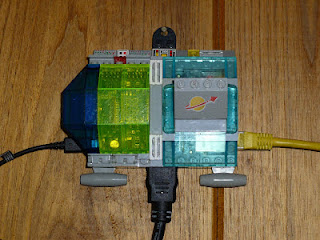
I purchased a Raspberry Pi last year, and inspired by a girl in Britain who assembled her own Pi case, I spent way too much time making my own Lego case:
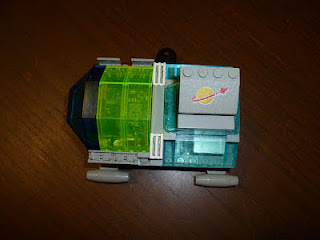
I made it so it could be mounted on the wall. Additionally, the left side opens to expose the GPIO pins, although I doubt you could fit something on them without having to remove pieces from the case.
A friend of mine also has a Pi, but he was using a plastic food container for its housing. I simply could not stand for this, so I created another case for him:
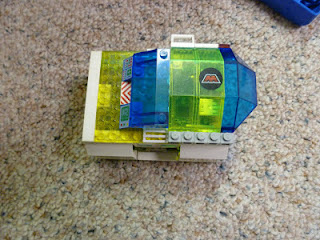
This one doesn't mount on the wall. I think he's just using it on an entertainment center near the cable modem box. Unlike my case, it opens fully, exposing the entire board. I forgot to take a picture of this feature, but you can see the hinges on one of the side photos.
Both of these cases use some classic Lego pieces that I received from my cousin when I was a kid. The old-school computer terminals in blue and grey and the pieces with space logos came from this set, and I mixed them with some newer space buttons and circuitry. The glass-like covers are also newer, but have a similar hokey space feel to them.
It was fun putting my old Legos to use again!

I made it so it could be mounted on the wall. Additionally, the left side opens to expose the GPIO pins, although I doubt you could fit something on them without having to remove pieces from the case.

A friend of mine also has a Pi, but he was using a plastic food container for its housing. I simply could not stand for this, so I created another case for him:

This one doesn't mount on the wall. I think he's just using it on an entertainment center near the cable modem box. Unlike my case, it opens fully, exposing the entire board. I forgot to take a picture of this feature, but you can see the hinges on one of the side photos.
Both of these cases use some classic Lego pieces that I received from my cousin when I was a kid. The old-school computer terminals in blue and grey and the pieces with space logos came from this set, and I mixed them with some newer space buttons and circuitry. The glass-like covers are also newer, but have a similar hokey space feel to them.
It was fun putting my old Legos to use again!
Subscribe to:
Posts (Atom)